What is Dark Spirituality?
Dark Spirituality is a newly developed framework that centres on one of the most puzzling paradoxes of our time: why are people experiencing record levels of anxiety, depression and loneliness when they are healthier, wealthier and living longer than ever before?
The term Dark Spirituality is inspired by literary critic Frank Kermode's description of Jesus' parables as "dark speeches", where meaning is never explicit and must be consciously worked at and brought to light. Dark Spirituality begins from the same conviction. As St Paul wrote, "we see through a glass, darkly", and true spiritual awakening comes from recognising and grappling with this element of our earthly existence.
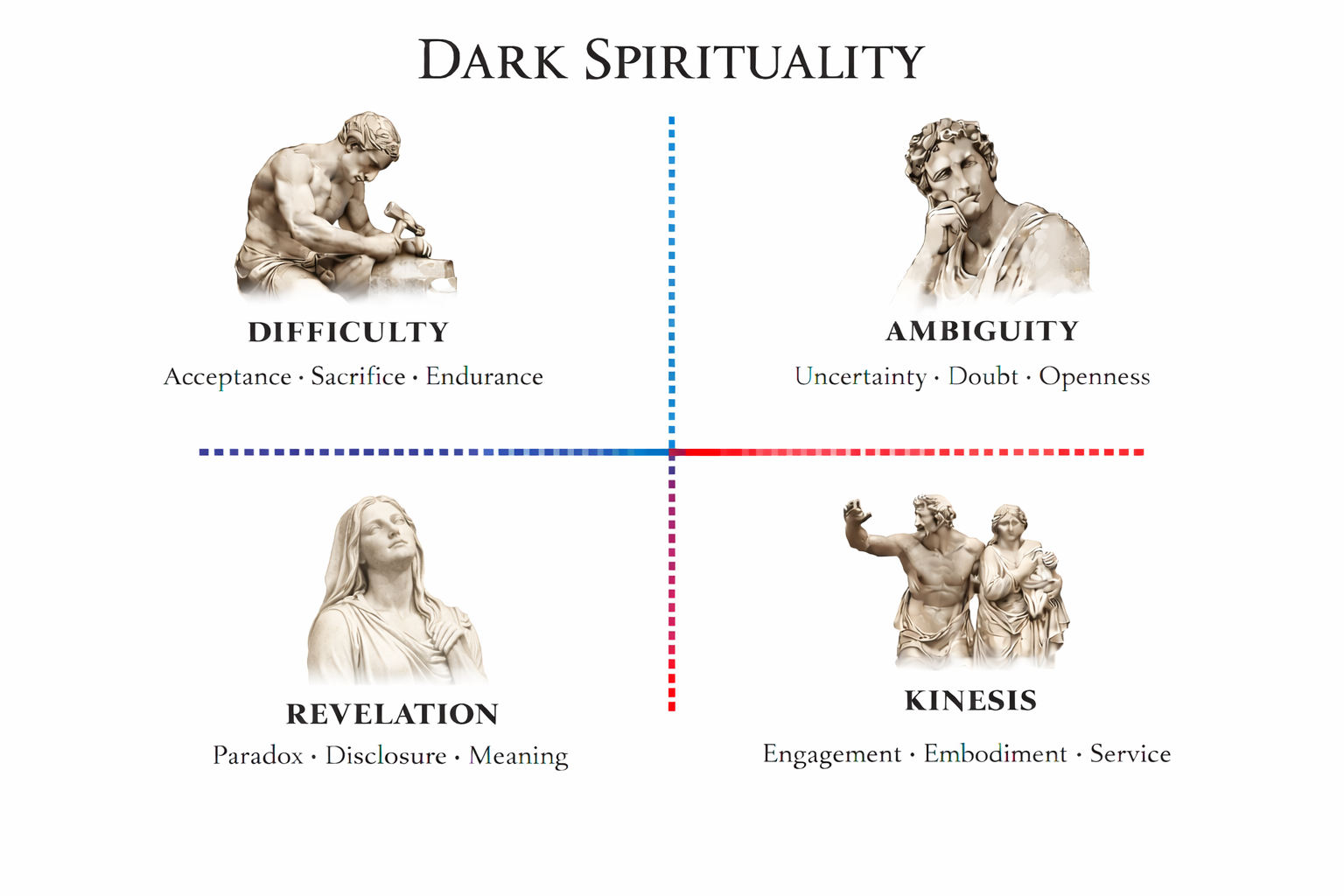
Within contemporary Western culture, two forms of spirituality have become particularly influential. Wellness Spirituality seeks fulfilment through wellbeing, mindfulness and self-optimisation. Nature Spirituality looks to the natural world as a source of healing and transcendence. While both offer important insights, neither fully recognises that the deepest forms of spiritual growth emerge through suffering and engagement with others. Dark Spirituality proposes another perspective and is structured around the acronym DARK, made up of four interrelated movements:
Difficulty
Human life is marked by suffering, frustration, loss, and failure. Dark Spirituality resists the temptation to avoid this reality. Instead, it challenges us to burn brightly by embracing difficulty, symbolised most powerfully by Good Friday, when Jesus suffered for the sake of others rather than prioritising his own comfort and material wellbeing. In a culture increasingly shaped by optimisation and self-improvement, Dark Spirituality reminds us to engage with life’s challenges rather than seeking to eliminate them.
Ambiguity
Many of the most significant moral and spiritual challenges young people face do not admit of simple answers. Dark Spirituality acknowledges ambiguity without abandoning moral seriousness. Certainty leads to spiritual suicide. In a culture hungry for certainty, ambiguity is both radical and refreshing. It encourages us to lean into life’s uncertainties, much like the spiritual practice of lectio divina, where sacred meaning unfolds slowly. This echoes the burgeoning bibliotherapy tradition in the West of using literature to help us live with unresolved moral and existential questions. Rather than eliminating ambiguity, Dark Spirituality encourages us to inhabit it, trusting that meaning often emerges slowly through reflection and experience.
Revelation
Meaning emerges slowly, often through paradox, patience and attention to what is given rather than dramatic epiphany or personal breakthrough. Dark Spirituality does not follow contemporary Western culture in dismissing revelatory moments as coincidences or mental malfunctions. They are meaningful in ways the rational mind cannot fully grasp. Revelation is often found not in extraordinary events, but in the smallest moments of everyday life, where beauty, sorrow and meaning quietly intersect. In a culture that treats rationality as the highest value, such moments are easy to ignore, yet they often contain profound truths.
Kinesis
Spiritual life is not static. In an age of passive scrolling and superficial connection, Dark Spirituality emphasises kinesis, calling us to engage with the wider world despite discomfort. Like a moth that springs to life only when the light is switched on, human beings come alive through interaction with others. For all of us introverts out there, this is perhaps the hardest aspect of Dark Spirituality to accept. Spiritual growth does not happen by stepping back from the world, but by stepping into it with intention and awareness.
Dark Spirituality is not opposed to wellbeing, nor is it a rejection of hope. Rather, it argues that genuine hope cannot be sustained without a truthful account of suffering and limitation.
Origins and public reception
Dark Spirituality emerged from sustained reflection on the conditions shaping contemporary education, particularly the sharp rise in anxiety, distress, and loss of meaning among young people. While these experiences are often framed in psychological terms, they frequently point to a deeper form of spiritual disorientation: a weakening of moral depth, existential coherence, and shared ways of making sense of suffering and limitation.
I first introduced Dark Spirituality publicly in late 2024 in an article for ABC Religion & Ethics, reflecting on Wim Wenders’ film Perfect Days. Following this publication, I discussed the concept on ABC Radio National’s Soul Search, where the conversation explored why many young people are searching for depth and seriousness beyond therapeutic reassurance, and how meaning often emerges through patience, disorientation, and lived attention rather than certainty or success.
The ideas were later taken up in an educational context through the Easter Oration at St Paul’s Cathedral, delivered to students and staff from Melbourne Grammar School at the invitation of the Senior Chaplain. The oration was subsequently published in The Australian, where it was cited in an editorial reflecting on the relationship between mental health, spirituality, and contemporary culture.
Dark Spirituality: A talk at St Paul’s Cathedral
This talk was given in early April 2025 as the Easter Oration at St Paul’s Cathedral, Melbourne. This was at the invitation of the Senior Chaplain of Melbourne Grammar School. The address explored the relationship between faith, suffering, and meaning in contemporary life, with particular attention to the spiritual conditions shaping young people today.
Click this link to watch the Easter Oration at St Paul’s Cathedral.
This talk was subsequently published in The Australian, where it appeared as a reflection on mental health, spirituality, and the moral conditions shaping contemporary life.
Click on links to access the published article and editorial in The Australian.
“Dr Adrian Rosenfeldt delivered the 2025 Easter Oration to some 1,200 staff and students of Melbourne Grammar School, at our end-of-term service in St Paul’s Cathedral. Adrian addressed the highly pertinent question: “why are young people experiencing record levels of loneliness, anxiety and depression, as the health, wealth and life expectancy of Australians increases?” His nuanced and well-researched address resonated with staff and students alike coming from diverse faith and non-faith backgrounds. I received numerous favourable comments afterwards such as: “this was the best Easter Oration we have had.” On a personal level, Adrian was a pleasure to work with from the earlier stages of planning the event through to the day itself. I would highly recommend Dr Rosenfeldt as a key-note speaker for school and other audiences. He is a sharp thinker, a gifted communicator, and a very approachable academic.”
Dr Hugh Kempster | Senior Chaplain Melbourne Grammar Senior School P +61 3 9865 7557 Wmgs.vic.edu.au
Appendix A: Easter Oration — St Paul’s Cathedral (Full Transcript)
How ‘Dark Spirituality’ can light the way for troubled youth
For this Easter oration I am going to confine myself to addressing just one question. But as this question contains a paradox, I will need your utmost attention. This is because a paradox is a statement that appears contradictory or absurd but on closer examination reveals a profound truth.
So here is the question: why are young people experiencing record levels of loneliness, anxiety and depression, as the health, wealth and life expectancy of Australians increases? Or, to put it another way, why is it that when Australians are healthier, wealthier and live longer than ever before, young people in this country are paradoxically experiencing increasing mental health problems?
In 2024, the Australian Institute of Health and Welfare reported that nearly one in five (18.3 per cent) Australians aged 16 to 24 experienced a mental disorder in the past year.
Critics have suggested different reasons for this paradoxical state of affairs: first, the lengthy lockdowns that occurred during the Covid epidemic; second, the technological revolution of the past 20 years – recent studies have found that adolescents spend, on average, 5 hours a day looking at screens; third, the precarious and short-term nature of the capitalist gig economy – many of you will go on to university but may still worry that, even with a degree, you will struggle to find secure and permanent employment; and last, the psychological stress that arises when much of the media promotes the threat of imminent environmental collapse and maintains that we have reached a so-called tipping point.
Although these four factors do have some bearing on the situation, I am going to argue that the decline in mental health among young people is primarily a problem of culture.
What do I mean when I use the term “culture”?
In 1952, anthropologists identified 152 definitions of culture. So how might we define something so elusive as Western culture today?
When teaching sociology and criminology at Melbourne University, I define culture as the customs, norms, rules and behaviours we take for granted that help us to make sense of the world. Like breathing, culture is so natural we don’t notice it.
So what are some of these norms and values that we take for granted in the West today?
I believe that the highest values in contemporary Western culture can be traced to three influential figures: Socrates, Martin Luther and Karl Marx. This might seem like an unlikely combination of historical influences but stay with me.
First, by using rational inquiry to question fundamental values like justice, truth, and love, Socrates prioritised reason over instincts and emotion. He was appalled that the great playwrights of his time drew inspiration from instincts rather than reason. This rationalist approach set the West on its path to separate the mind from the body.
Second, Luther’s distrust of large church institutions and the priesthood shifted the weight of religious responsibility on to the individual, encapsulated in his rallying cry “sola fide” – through faith alone. The emphasis on “alone” is the foundation of modern individualism, moving away from collective responsibility.
Last, Marx famously upturned spiritual understandings of existence in favour of a material world view based on power and class struggles, reducing religion to an “opiate of the people” that would be unnecessary when perfect equality was achieved.
The ideas put forward by these three figures – rationalism, individualism, and materialism – have shaped a Western culture that prioritises power, scientific materialism and individual freedom, and neglects the spiritual and communal aspects of life. Some of you might be thinking, what’s wrong with individual responsibility and scientific materialism? Haven’t they led to progress?
Since the Age of Enlightenment, the West has been part of a 500-year experiment, where while inventing the wonders of the modern world, from air travel to penicillin, we have at the same time created a culture that attempts to live without a spiritual nature. We are one of the only cultures or societies that has attempted to do this.
So how does all this relate to the increase in anxiety, depression and loneliness among young people in Australia? The Swiss psychologist Carl Jung perhaps put it best when he said, “the Gods have become diseases”, meaning that in the West the rise in mental health problems is a direct result of not acknowledging our inherent religious and spiritual nature. Jung argued it is not possible to expunge or extract spirituality from human existence without profound consequences. While we need material things, such as food, air and water, our lives derive meaning from the spiritual – without it, we wither, and our behaviour becomes sick.
But what in fact is spirituality?
Like the term culture, spirituality is also difficult to define, especially as it often relates to subjective spiritual states that have been marginalised in our current materialistic culture.
But having said this, in my estimation, there are currently two dominant forms of spirituality recognisable in Western culture today, Wellness Spirituality and Nature Spirituality.
Wellness Spirituality focuses on personal growth and inner peace through practices like mindfulness and New Age self-optimisation, encouraging individuals to treat wellness as a self-managed task, much like a fitness regimen. Think of a Fitbit that you wear around your wrist. This material electronic device calculates if you have had a good sleep, how many steps you have walked in a day, and ultimately places responsibility for wellbeing entirely on the individual, framing failure as a personal shortcoming – you have not worked hard enough!
In contrast, Nature Spirituality idealises a harmonious connection with the natural world, romanticising it as a refuge from human suffering brought on by civilisation. The 1960s’ return-to-nature counterculture epitomised this movement, but ultimately led to disengagement from the mainstream community without offering any serious alternative.
Therefore, I believe that Wellness Spirituality and Nature Spirituality do not offer a meaningful counterpoint to contemporary Western culture. They are either too individualistic, rationalistic or materialistic.
So, what is the way forward?
There have been two key moments in my life that forced me to reflect on the spiritual dimensions of human existence, particularly the aspects that are often overlooked in our culture today.
The first was climbing Mount Sinai during a visit to Egypt in my early 20s, where Moses is said to have received the Ten Commandments from God – something that my rational Western worldview found hard to believe. Yet, as I reached the summit at sunrise, after an exhausting all-night ascent up a rocky path, awe displaced disbelief. The silence that surrounded me, the warm breeze and the dazzling desert starlight informed me that I was in a sacred place as I climbed the final giant steps – 3700 in all – that were carved into the rock by a monk as penance. And to feel the sheer size of Mount Sinai towering above the flat desert landscape, how could I possibly see myself as a mere individual tourist in an exotic setting? I was a Son of God going up into the black heavens to have the Word revealed to me. I was surprised I felt this way. It seemed that without being consciously aware of it, I had just participated in a significant collective ritual connected to my Judeo-Christian heritage.
The second spiritual experience came in a much more mundane setting. Twenty-four hours before my philosophy essay was due, I worked relentlessly throughout the night, driven to the edge of my capabilities. Time seemed to disappear as I became absorbed in every sentence, working intently to make sense of many disparate ideas and themes. When the essay finally came together at dawn, a strange sense of wellbeing washed over me. Despite the exhaustion, I felt something deeply spiritual, as if I had transcended all my material concerns in that long sleepless night.
What are the common characteristics of these two experiences? They both involve stepping outside of everyday linear time and into darkness, a lack of food and sleep, mental or physical exertion, and a feeling that I was doing something transformative and significant.
Much like many foundational religious figures in the West, from Moses to Jesus Christ, my spiritual experiences arose when I stepped outside my comfort zone and was transformed – rather as base metals are transformed only when they experience intense pressure.
And it is not just religious figures who seek uncomfortable spiritual transformation; this is also true of prophets, great artists, and political dissidents. Think of philosophers such as Nietzsche and Kierkegaard, artists such as Van Gogh and Kurt Cobain, and Alexei Navalny, the Russian opposition leader who lost his life standing up to Putin.
As we approach Easter, it is worth noting that all these disparate figures I have mentioned share one striking similarity with Jesus: they faced extreme trials that led to the creation of something powerful and unique, blazing with spiritual intensity. Rather than focusing on personal wellbeing or escaping into nature, they sought to serve humanity. In a Western culture that worships longevity, it’s significant that neither Jesus nor the prophets, artists, or dissidents lived long lives.
To return to the paradoxical question with which we began, I suggest that if longevity, health, wealth, wellness and nature spirituality are paradoxically exasperating mental health problems among the young in Australia, there needs to be room for a third and more challenging countercultural type of spirituality, that I call “Dark Spirituality”.
Now DARK is an acronym that stands for difficult, ambiguous, revelatory, and kinetic. As St Paul once said, we see through a glass darkly on earth, and true spiritual awakening comes from recognising this.
To best understand Dark Spirituality, we can reflect on the upcoming Easter ritual.
First, the “D” of Dark Spirituality stands for difficulty. When life challenges you, burn brightly without concern for tomorrow. Do not shy away from difficult situations or the darkness that is best represented by Good Friday, when Jesus suffered for the sake of others and did not prioritise his individual power and material wellbeing.
Second, do not try to avoid the “a” in Dark Spirituality, ambiguity – this is necessary for all spiritual transformation. Despite what religious fundamentalists may think, certainty is spiritual suicide. Jesus was not free from ambiguity and doubt in the days before he died – this is what makes him both human and spiritual. Think of his cry on the cross: “My God, my God, why have you abandoned me?”
Third, do not follow contemporary Western culture and dismiss the “r” in Dark Spirituality, namely revelatory moments when they come to you, as being mere coincidences or mental malfunctions. They are meaningful in a way that your rational mind cannot understand. Jesus’s crucifixion itself is one such revelation – a paradox where death leads to life, and suffering becomes a source of redemption. Living in a culture that values rationality as the highest value, it is easy to ignore such paradoxical moments, but as we shall see today, these moments contain profound truths.
Lastly, do not disassociate from your community and friends, take part in the “k” in Dark Spirituality, kinetic engagement with the wider world. Like a moth that is still in darkness and springs to life only when the light turns on, human beings run on kinetic energy that is activated by external stimuli. For all of us introverts out there, this is perhaps the hardest thing to accept. When I was asked to speak in front of all of you, there was a part of me that wanted to run in the opposite direction. And yet, here I am. My physical body is just a conduit for a larger spiritual message that needs to be shared, despite my personal discomfort. Jesus’s own life exemplified this principle – his ministry was one of deep engagement with others, reaching out and embracing the suffering that came with it.
And now, we can finally properly answer the paradoxical question from which we began: the rise in anxiety, depression and loneliness among young people stems from a lack of meaningful spiritual challenges in our culture. Instead, contemporary Western culture contributes to the growing mental health crisis by prioritising comfort, longevity, rationality, individual power and material wealth.
I believe that Dark Spirituality – difficult, ambiguous, revelatory, and kinetic – offers a startling solution to this predicament, one that invites us not to shy away from sleepless nights and difficult trials, to dance on the edge of rationality, and to seek purpose beyond individual material comfort. Jesus’s challenging question, “What shall it profit a man if he gains the whole world but loses his soul?” shows us the danger of a solely individualistic materialistic worldview.
Therefore, it’s time we embrace this Dark Spirituality – a pathway to fulfilment and resilience that properly addresses the mental health challenges in Australia and fills the current spiritual void in our culture.